
Research
Agentic Commerce, 18 Months In: Where The Market Stands Today, Who Is Positioned To Win, And Where Value Is Forming
Kayla Phillips
October 21, 2026
Agentic commerce has been covered extensively over the past 18 months, but most of this attention went to the early narrative. Initial hype peaked between Sept 2025 and Jan 2026: Stripe and OpenAI’s ACP, Instant Checkout’s promise of a million Shopify merchants, Mastercard Agent Pay, Google AP2’s 60+ launch partners, UCP. These big announcements drew a wave of general explainers and thought pieces at the moment of maximum promise and minimum evidence.
But in the last couple months, we have entered a new chapter in the Gartner cycle: the early trough phase. You may not have noticed given the general buzz around AI, but content analysis over this time reflects that agentic commerce hype has begun to cool and publishing volume has started to thin out, just as real product and sector development begins to progress.
So, where is agentic commerce today? Now that the opportunity has advanced beyond an idea and early products and transaction data exist, it is worth revisiting the space in its current state, the validity of early promises and theses, and realistic projections for the future. Below is a deeper dive into agentic commerce that separates reality from hype. We cover the agentic commerce tech stack, key industry players, competitive dynamics and motivations behind them, where value accrual and moats are forming, whitespace opportunities across different vertical use cases, and the subtle distinctions between the headlines companies are publishing vs the strategic actions they are taking.
Agentic Commerce Overview
The agentic commerce sector is typically discussed as one large, fast-emerging market opportunity. That framing flattens an important distinction: the layers of the agentic commerce stack differ sharply in how much value each captures and which players are best positioned to capture it. To assess where the sector is headed and who stands to benefit as it matures, we have broken the sector into its parts along two axes: 6 horizontal layers by function and 3 vertical segments by use case.
Horizontal Functional Layers:
- Layer 6 - Agent App Layer: Where purchase intent originates. General AI agents and vertical agents that convert a user request into a purchase decision.
- Layer 5 - Agent Discovery & Communication: How agents find and communicate with other agents, merchants, and tools.
- Layer 4 - Identity & Authorization: Who the agent is, who authorized it, and what it is permitted to spend. Agent credentials, wallets, mandates, spend caps, and policy controls.
- Layer 3 - Commerce & Payment Protocols: The standards used to initiate and execute an agent transaction.
- Layer 2 - PSPs & Merchant Acceptance: Payment processing on the merchant side: acceptance, fraud screening, and payout.
- Layer 1 - Settlement Rails: Payment settlement via: card networks, stablecoin rails, and bank rails.
Vertical Use Cases:
- B2C - Personal Shopping Assistants: Consumer agents that browse catalogs, compare pricing, and purchase household goods or travel within user-defined preferences and spending limits.
- M2M - Machine-to-Machine Micropayments: High-frequency, sub-dollar transactions in which agents pay other agents or servers for data streams, API calls, and compute.
- B2B - Enterprise Procurement & Invoicing: Enterprise agents that apply corporate policy, perform three-way invoice matching, execute purchase orders, and settle vendor payments.
Below we dive deeper into these horizontal layers and vertical use cases.
Agentic Commerce Stack: By Layer
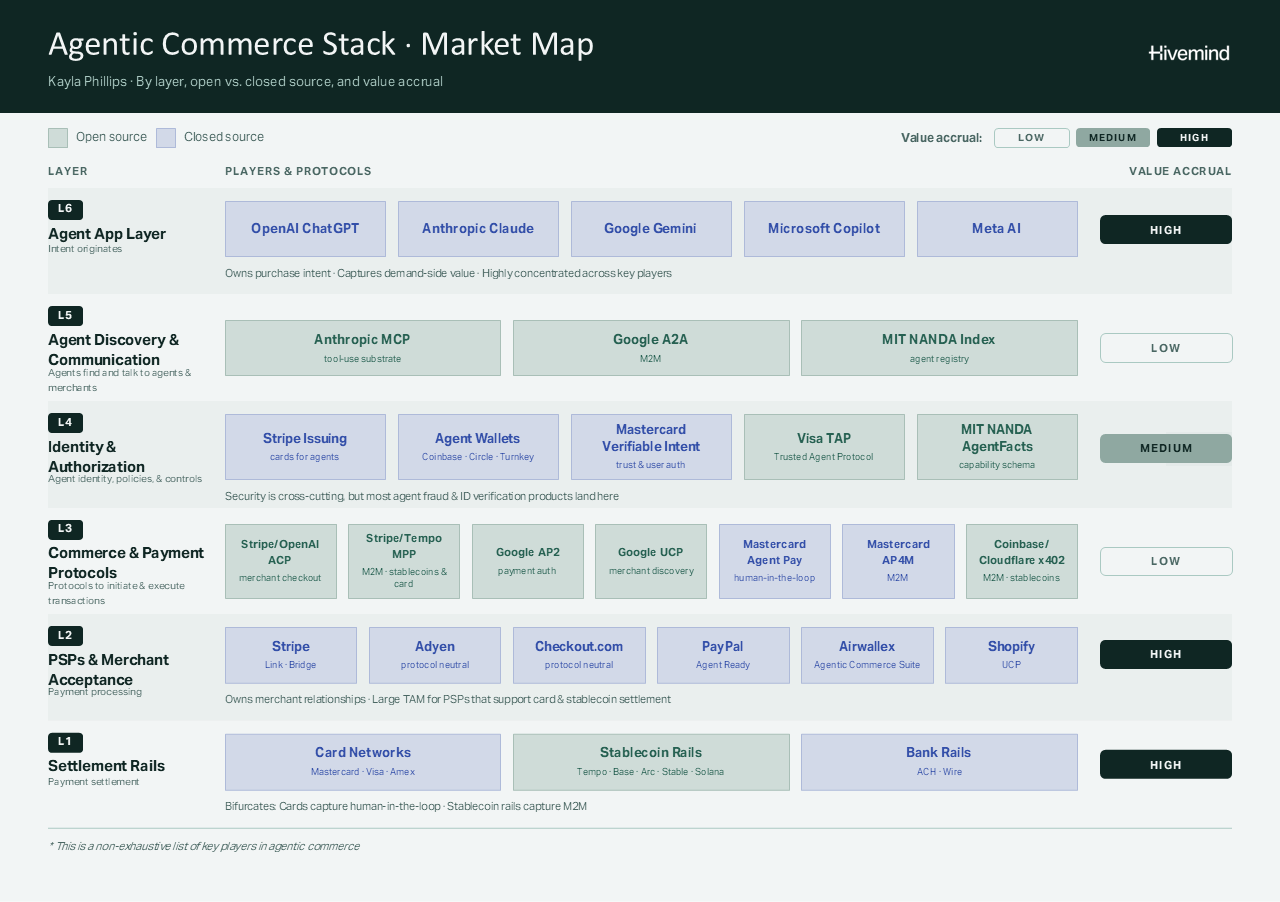
The market map above breaks out the horizontal layers of the agentic commerce stack, including the key players, open vs closed source products, and the value accrual at each layer. Across the 6-layer stack, value concentrates at the two ends: intent origination at the top and money movement at the bottom. The companies building the middle layers of the stack are intentionally commoditizing them. The open vs closed source pattern on the market map reflects strategy rather than engineering culture. Each major player keeps the layer where it monetizes closed source and open-sources the adjacent layers, preventing others from establishing a tollbooth between it and the transaction. This barbell structure, with high value accrual at the agent app layer (L6), merchant acceptance (L2), and settlement (L1), and low accrual in the protocol layers between them, is the lens applied throughout the rest of this piece.
L6 - Agent App Layer (Closed source; High value accrual)
This layer is where purchase intent originates and players own the valuable end-user relationship. ChatGPT, Claude, Gemini, Copilot, and Meta AI compress product discovery and comparison into a single recommendation, repeating a similar playbook as search in the internet era. This layer is extremely competitive and concentrated among the leading general-purpose AI platforms, whose durable advantage is distribution, reputation, and status quo. The horizontal version of this layer is effectively closed to startups. The open question is whether vertical agents (i.e. procurement, travel, ecommerce, etc) can own intent within a domain before the general assistants absorb those use cases.
L5 - Agent Discovery & Communication (Open source; Low value accrual)
MCP, A2A, and the NANDA Index function like DNS and SMTP: broadly necessary and difficult to monetize, because standards succeed through ubiquity rather than margin. Registries are a partial exception. If agent trust and reputation attach to a registry (which agent is this, what is it permitted to do), solutions at this layer start looking more like a credit bureau than plumbing. In practice, this trust function is migrating one layer down, to L4.
L4 - Identity & Authorization (Mixed; Medium value accrual)
Every agent transaction must establish who authorized it and within what bounds. Visa TAP and Mastercard Verifiable Intent are the card networks’ answers; Stripe Issuing provisions cards for agents; Coinbase, Circle, Privy (Stripe), Turnkey, and Skyfire are building agent wallets with keys and spend caps; NANDA AgentFacts defines a capability schema. While security is cross-cutting, most agent fraud and identity products land here, with regulation likely to force spending into this layer. Know-your-agent (KYA) requirements today resemble KYC in 2012: fragmented and immature, but likely mandatory over time and valuable to whoever standardizes them.
L3 - Commerce & Payment Protocols (Open source; Low value accrual)
Seven agentic commerce and payment protocols have launched in roughly 18 months: ACP (Stripe/OpenAI), AP2 and UCP (Google), Agent Pay and AP4M (Mastercard), MPP (Stripe/Tempo), and x402 (Coinbase/Cloudflare). This is a standards contest in which the protocol itself is not the prize. Each sponsor open-sources L3 to route transaction flow toward the layer where it monetizes: Stripe toward processing, Google toward its surfaces and authentication, the card networks toward interchange and tokenization, and Coinbase toward Base and custody. Consolidation to 2-3 surviving protocols, segmented by use case, is the likely outcome, with little value captured by the protocols directly.
L2 - PSPs & Merchant Acceptance (Closed source; High value accrual)
Stripe, Adyen, Checkout.com, PayPal, Airwallex, and Shopify own the merchant relationship. Agents change who initiates checkout, but not who needs acceptance, fraud screening, and payout. PSPs benefit by remaining L3 protocol agnostic to capture transaction volume, regardless of the protocol used. The defensible asset is the merchant network and the transaction data it generates.
L1 - Settlement Rails (Mixed; High value accrual)
Settlement is bifurcating based on whether a human is in the loop. Card rails, with interchange and reversibility, serve human-in-the-loop commerce, because reversibility matters when a person may dispute a charge. Stablecoin rails (Tempo, Base, Arc, Stable, Solana) serve machine-to-machine payments, where micro-transaction fees and instant finality are needed and disputes are not expected. The two use cases divide the market, rather than these rail types competing directly for the same transaction flows.
Defensible Moats: The strongest long-term moats exist among players who own the end-user relationship (L6), players who own the merchant relationship (L2), and players who own the settlement network (L1). Second to these is the emerging identity and authorization (L4) category. While still in its early days, the L4 players that emerge as the leaders in KYA and agentic security/fraud will likely build solid, defensible moats.
Players Expanding Across the Stack
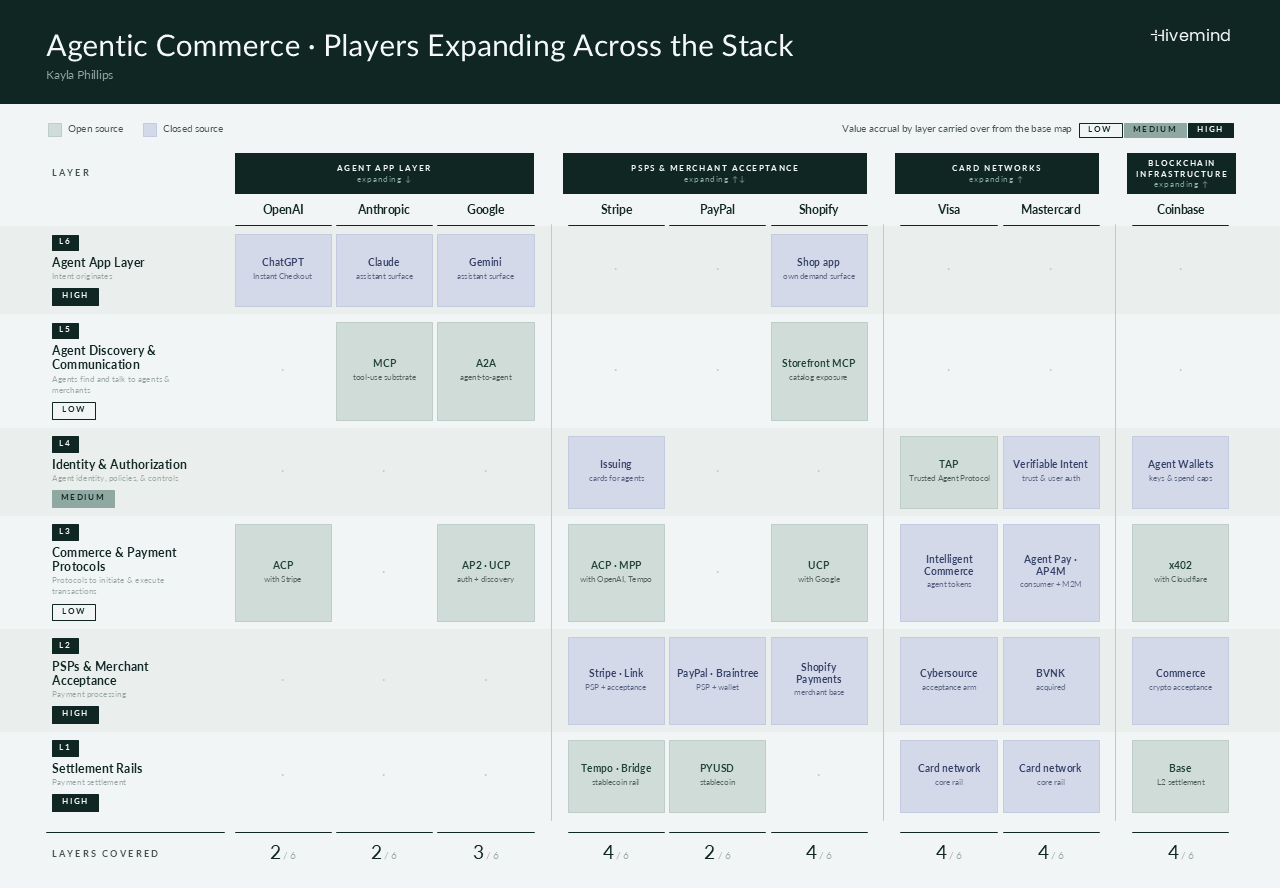
Each incumbent on the map above has entered agentic commerce from a position of strength in one high value layer: app layer (L6), merchant acceptance (L2), or settlement (L1). Agentic commerce presents a landgrab opportunity for these players to capture new market share and establish a permanent foothold in the emerging category by controlling as much of the end-to-end transaction flow as they can. The first agent protocols and standards to reach scale will be challenging to displace later, so incumbents are rushing to launch new products and standards across multiple layers for an early-mover advantage. The map illustrates how these players are expanding in response to this whitespace.
Bidirectional expansion: Incumbents at either end of the stack are scaling towards the other end. The incumbents that own the user relationship at the app layer (L6) are scaling downwards towards the infrastructure layers (L1, L2) that own the merchant relationship and settlement, while those that own the infrastructure layers (L1, L2) are scaling upwards towards the app layer (L6) that owns the user relationship. Few incumbents are leapfrogging; most are moving into adjacent layers. Owning more of the middle layers allows them to control more of the stack and route more transaction flow through their dominant layer(s).
A closer look at each player:
OpenAI holds a highly coveted position at the consumer app layer, yet it does not have coverage in adjacent layers of the stack to support it after shuttering[1] its Instant Checkout product in March 2026. Google and Anthropic also hold strong positions at the app layer, but have not expanded into core payments infrastructure at L2 and L1 (despite the existence of Google Pay). Stripe has broad horizontal coverage and is expanding bidirectionally across the stack, downwards with Tempo and Bridge at settlement (L1), and upwards with ACP and MPP (L3) and Issuing (L4) - a position that pays off whichever rail and protocol prevail. Meanwhile, PayPal has its core PSP business, plus a consumer audience, wallet, and PYUSD (which could be used to support agentic stablecoin settlement), but has not committed to either end of the stack.
Shopify is the only player that competes at both ends of the barbell, with the Shop app at L6 and Shopify Payments (a partnership with Stripe) at L2, holding a strong position with both consumers and merchants. One key advantage that Shopify holds over the rest of these players is that it owns the storefront. It has already upgraded its merchant base to be agent-ready, so Shopify stores now expose an MCP endpoint by default. Its gaps, L4 and L1, are both partnerable.
Visa and Mastercard are running their 2014 tokenization playbook. When mobile wallets created an origination point they did not own, the networks made themselves the mandatory credential issuer inside it, and sold that position to issuers on fraud and authorization economics. With TAP, Verifiable Intent, Intelligent Commerce agent tokens, and Agent Pay, Visa and Mastercard apply this same strategy to agents. However, they are still missing the liability rulebook for agentic commerce that made tokenization stick. This is the more valuable half of the position and the card networks have not written it yet.
Coinbase is the only player building up from crypto infrastructure with a sole focus on M2M. As such, it is the only player whose position does not depend on consumer shopping behaviors changing.
The core competency divide: No player covers more than 2 of 3 high value layers because a competency boundary runs through the middle of the stack. L6 and L5 reward model quality, user experience, and distribution. L2 and L1 reward payments infrastructure and regulatory licensing. Crossing that boundary comes with high risk and a low rate of success. It requires funding a business line outside one’s core competency, hiring against a different talent pool, entering as a challenger against entrenched leaders, and accepting the risk of diluting the overall strength of the business. As an example, OpenAI wound down[2] its Instant Checkout product 6 months after it launched because it “underestimated how difficult the enablement of transactions was going to be.”
Crowded middle layers: The middle layers L4 and L3 are potentially feasible from both the infrastructure and the app players, which is why these layers carry more competitive activity than their revenue potential likely justifies. The middle layers also see greater product partnerships between the infrastructure and app players, including OpenAI/Stripe’s ACP and Google/Shopify’s UCP.
Identity & Authorization (L4) is still early: While a number of the payments infrastructure players - Visa, Mastercard, Stripe, Coinbase - have planted their flag at the Identity & Authorization layer (L4) with early products, their presence today remains shallow with limited agent policy enforcement and a lack of liability rules. Agent permission controls need to be at least as granular and robust as what exists in traditional payments today. So far, they have a limited set of controls: spending limit, merchant scope, and consent policy checked at authorization. Meanwhile, traditional corporate cards can be restricted by merchant category, country, and individual merchant, with separate spending caps per transaction, per day, week, month, year, and for the life of the card - all of which are checked and declined before the purchase is approved. Agent controls cover governance for a single purchase but cover substantially less than what corporate card policies would provide a finance team. Additionally, the key question of ‘who pays when an agent buys the wrong thing’ remains unresolved. We expect payments infrastructure players to expand deeper at this layer, moving from provisioning, credentialing, and identity into governance and liability.
Build, buy, or partner: The remaining gaps present each player with a build, buy, or partner decision, though these options are not equally attainable. Building across the competency boundary is risky and off-strategy. Buying is realistic mainly at L4, where the assets are small, numerous, and inexpensive relative to the layer’s eventual value to one of these acquirers. Consequently, consolidation should appear here first. M&A is unlikely at the 3 high-value layers (app, PSP, settlement), because the desirable targets are either not for sale or too expensive. Therefore, partnership becomes an incumbent’s best path forward to access the high-value layers it is missing from counterparts at the opposite end of the stack. Players enter these partnerships with the aim of routing as much volume as possible through the layer in which they monetize, and treating the rest of the stack as their cost of distribution.
Partnerships are dynamic and can change or end when better opportunities emerge. Leverage within partnerships can also shift over time. Near term, agent transactions are bottlenecked by merchant readiness rather than user demand, so leverage sits with the merchant side. This means that Shopify and others that control the merchant storefront set the terms. Once merchants are onboarded, end-user adoption will become the main bottleneck and power will shift toward whoever owns the consumer relationship. The likely sequence is broad, non-exclusive partnerships while volume is small, followed by consolidation into a handful of exclusive partnerships once volume ramps up meaningfully.
Agentic Commerce Stack: By Use Case
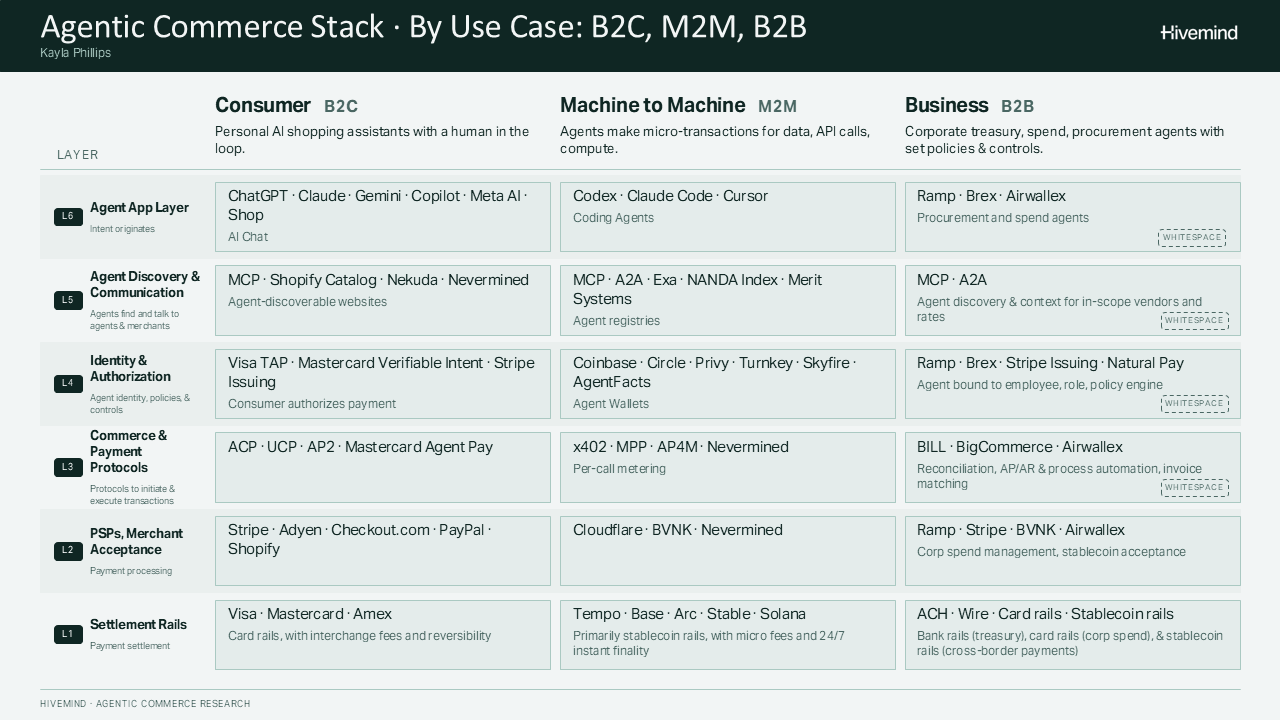
Here, we break out the agentic commerce market by vertical use case to show how far each application of the tech has progressed. Across use cases, B2C is unsurprisingly furthest along the adoption curve with the largest headline numbers to date - consumers factor in fewer risks than businesses when adopting new technologies. M2M is still mostly experimental and its activity reflects this; it’s the 0-1 opportunity across this set. B2B automates existing processes and workflows, building off what already exists; its path to adoption is the most concrete and understood, despite having the most whitespace left to tackle.
B2C:
Consumer agentic shopping has the most activity today, capturing 63.4%[3] ($3.74B) of total agentic commerce revenue today. However, this headline is somewhat misleading as B2C agents are primarily being used for discovery and influencing purchase behavior, rather than for actual transaction execution. AI-referred traffic to online retailers is driving 42%[4] higher purchase conversion than traditional search. Agent-executed checkout remains at an early stage but will continue to gain adoption as users grow more comfortable and trusting of the technology.
B2C has the most entrenched incumbents across its stack vs other use cases, leaving little room for new entrants to compete. But one opportunity that still exists for newcomers is to support merchant-side agent readiness - startups like Nekuda and Nevermined (L5) are competing here.
M2M:
Machine-to-machine is a net-new category for agents buying data, API calls, and compute. Current volumes are small, high-frequency, and still mostly experimental. For the month of Sept 2026, x402 and MPP processed a total of $972K[5] across 17.4M transactions (avg $0.06/tx) - reflecting minimal transaction activity and economics that favor stablecoin rails over card settlement. M2M has potential to grow into a large market, so projects building for M2M have plenty of upside potential. However, it is still too early to confidently predict the expected size of this market. This market will ramp up as 1) more sellers adopt instant, usage-based payment, and 2) more agents are trusted to hold and operate budgets without human intervention.
Given the newness of this vertical, there are no entrenched incumbents yet, and agent registries, governance, and wallets remain early and fragmented. The one potential exception is x402, Coinbase and Cloudflare’s protocol and the leading M2M payments standard (L3). It directs transaction volume to Cloudflare for metering (L2) and to Base for settlement (L1), though the protocol is open to other metering and settlement providers. Its flow is distinct: it settles each payment individually, which can strain economics for the smallest micro-transactions. Competing approaches handle this differently. MPP offers a “sessions” feature for streaming payments, and Nevermined (which acts as a protocol-agnostic orchestration layer) uses a prepaid credit model to batch them. With meaningful adoption still ahead and the leading M2M business model undetermined, it is too early to claim that Cloudflare and Coinbase have won the high-value L1 and L2 layers of the M2M stack.
B2B:
B2B use cases including corporate procurement, treasury, payments, and AP/AR offer the clearest path to near-term revenue and the largest long-term opportunity. Adoption is most concrete in B2B. Nearly 40%[6] of B2B buyers are already using agents in their purchasing process – primarily at the research, evaluation, and compliance stages vs true autonomous payment execution - and agents are projected to facilitate $15T[7] in B2B purchases by 2028.
Defensibility in B2B develops as a flywheel. An agent bound to an employee, role, and policy engine generates reconciliation and invoice-matching data specific to a given company, employee, and role with every purchase. This improves automation accuracy for that customer, builds trust that leads to greater agent spend authority and autonomy over time, and increases switching costs for a sustainable moat. Given the bespoke nature of B2B, it will be harder to develop industry agentic standards for invoicing, supplier payments, or M2M negotiations. As a result, this market will not be winner-take-all, but will instead likely verticalize, with 1-2 leaders dominating each vertical like what we have seen with B2B vertical-specific AI and SaaS. The B2B use case presents a massive market with the most whitespace across agentic commerce, making it particularly well-suited for new entrants competing to become category leaders.
Players competing by use case: Visa and Mastercard are primarily focused on B2C (TAP, Agent Pay), yet are supporting B2B through virtual-card infrastructure, and Mastercard specifically is expanding into M2M with AP4M. Stripe has a presence across all 3 use cases. Coinbase and Cloudflare are M2M-native. Ramp, Brex, and Airwallex own the B2B app layer.
How this will likely play out: Card networks will continue their expansion beyond traditional card settlement, evolving into universal settlement networks that support card & stablecoin settlement, so they can capture the market opportunity across all 3 use cases. Stripe will further define and bundle its stack by use case. The B2B whitespace will shrink as competition heightens: fintechs that already hold corporate spend relationships vs startups that develop vertical-specific niches vs startups that launch better agentic policy/identity products.
Remaining Bottlenecks
Liability: Outside of fraud, no industry framework yet determines who bears the loss when an agent transacts in error. Regulation E was not written for consumers delegating purchasing authority to software, and whether general permission to shop covers a specific purchase is legally unresolved. Chargebacks on agent purchases are expected to be higher than on human purchases, as agents will inevitably make mistakes. This will impact merchants’ dispute ratios, making some merchants understandably cautious to support agent transactions.
Merchant readiness: Merchant readiness is stalled due to upgrades needed to merchant front-ends. Mid-market storefronts lack server-rendered content and crawler access. A meaningful share of retailers also block agents outright, reflecting an unresolved tension between owning the customer relationship and being accessible to agents.
Identity & protocol fragmentation: Multiple competing approaches to delegated authority (AP2 mandates, Visa TAP, Mastercard Verifiable Intent) and several wallet architectures mean merchants cannot verify an agent, its principal, and that the agent is acting within its defined policies in a standard way. Protocol fragmentation at L3 compounds the problem and encourages merchants to wait until consensus forms around an industry standard.
B2B data: Most of the training and verification data B2B systems require sits trapped in ERP custom fields, procurement email threads, and PDF contracts. Thus, those tackling the B2B agentic opportunity first need to build the pipes to generate this data at scale before they can automate these workflows.
Regulatory Outlook
As is typical with emerging tech, agentic commerce regulation lags behind its technical and commercial progress. No major global jurisdiction has passed a law specific to agentic commerce yet, so agents are currently governed by existing rules built for human buyers.
In the US, consumer payment protections hinge on whether a transaction was authorized. But it is unclear whether giving an agent your payment credentials counts as authorizing every purchase it makes, so consumers’ ability to dispute an agent’s mistakes remains unresolved. Apart from purchase liability, a recently introduced bill, the AI AGENT Act proposes technical standards and an FTC registry for trusted agents. GENIUS Act also clears the way for stablecoin settlement, a catalyst for the M2M use case.
The EU is progressing with several broader regulatory frameworks that address different areas of agentic commerce. The EU AI Act is the world’s most aggressive overarching AI framework to date. It will classify agents with autonomous purchasing power as high-risk, requiring them to have strict controls and audit trails.
Asia is arguably furthest along, though via regulatory guidance rather than law. Singapore’s central bank has confirmed that AI agents fall within its existing supervisory guidelines, meaning a bank deploying financial agents must apply its AI governance framework and be held accountable for its agents’ actions. China recently issued agentic payment guidelines, including KYA verification and similar liability for financial institutions’ agentic transactions.
Looking ahead, the first consequential rules are likely to be private rather than statutory. Network-defined liability rules for credentialed agents, comparable to the 2015 EMV liability shift, would let Visa and Mastercard set safe-harbor terms for their own agent credentials before legislation arrives. Beyond that, likely developments include KYA requirements modeled on KYC, standardization of mandate and consent records as dispute evidence, Europe’s PSD3 payments rulebook bringing agent payments under open-banking supervision, and eventual antitrust activity around purchase intent, given similar legal precedent set with search algos manipulating purchase behavior.
Conclusion
Agentic commerce has entered a trough just as real progress and activity is starting. Coverage has thinned, but the work now underway matters more than the launches that drove the early narrative: incumbents are building moats around their core competencies for an agentic future, partnerships are forming across the divide between AI and payments leaders, and the open questions around liability, agent identity, merchant readiness, metering, and data are now being addressed head on. The market that emerges will be slower and less evenly distributed than the early headlines implied, with most of the value settling with the players who already hold the user, the merchant, or the settlement layer. The opening for everyone else is trust. Agents will only transact at scale once consumers, merchants, and finance teams are comfortable handing them real spending authority. The rules, controls, and data that make that possible are still being written, and whoever writes them will shape how agentic commerce works once the volume arrives.
--
[1] “OpenAI’s First Crack atOnline Shopping Stumbled. It’s Preparing for the Next Wave,” CNBC, March 20,2026, https://www.cnbc.com/2026/03/20/open-ai-agentic-shopping-etsy-shopify-walmart-amazon.html.
[2] “OpenAI’s First Crack atOnline Shopping Stumbled. It’s Preparing for the Next Wave,” CNBC, March 20,2026, https://www.cnbc.com/2026/03/20/open-ai-agentic-shopping-etsy-shopify-walmart-amazon.html.
[3] Globe Market Research,“Agentic Commerce Market to Surpass USD 95.2 Billion by 2035,” July 31, 2026, https://www.globemarketresearch.com/reports/agentic-commerce-market.
[4] Vivek Pandya, “AdobeReport: U.S. Retailers See Surge in AI Traffic, but Many Websites Are NotEntirely Readable by Machines,” Adobe for Business Blog, April 16, 2026, https://business.adobe.com/blog/ai-traffic-surge-retail-sites-not-machine-readable.
[5] @shafu0x, “x402 vs MPP,” protocol activitydashboard, https://x402vsmpp.dev/.
[6] Apurva Pangam, GaganMehra, and Paul do Forno, “Agentic Commerce: The Future of B2B Commerce,”Deloitte, June 26, 2026, https://www.deloitte.com/us/en/what-we-do/capabilities/applied-artificial-intelligence/articles/b2b-agentic-commerce.html.
[7] MarketScale Newsroom,“Zero-Click Commerce Arrives: AI Agents Set to Intermediate $15 Trillion in B2BPurchases by 2028,” MarketScale, June 17, 2026, https://www.marketscale.com/industries/retail/zero-click-commerce-arrives-ai-agents-set-to-intermediate-15-trillion-in-b2b-purchases-by-2028.
--
DISCLAIMER: All views expressed are Hivemind’s own views. The information provided herein has been produced and issued by Hivemind Capital Partners UK LLP and/or Hivemind Capital Partners LLC (“Hivemind”) and is being provided for informational purposes only. This document is not to be distributed or reproduced in any way. This document does not constitute or contain an offer to purchase or sell securities. This document is confidential and intended for the person to whom this was delivered. If you have not received this document from Hivemind you are hereby notified that you have received it from a non-authorized source and you are prohibited from reading, using, retaining, disseminating or copying this material without the prior express written consent of Hivemind. Neither Hivemind nor any of its affiliates or representatives makes any representation or warranty, express or implied, as to the accuracy or completeness of the information contained herein or any other written or oral communication transmitted or made to the recipient. The information contained in this document is current as of the date indicated, and Hivemind undertakes no obligation to update, modify or amend this document or to otherwise notify a reader in the event that any matter stated herein changes or subsequently becomes inaccurate. This document has not been compiled, reviewed, or audited by an independent accountant. Past performance should not be construed as an indicator of future results, and there can be no assurance that historical trends will continue. This document does not include information regarding each investment or investment strategy pursued by the Funds. References to investments included herein should not be construed as a recommendation of any particular investment. Certain information contained herein may constitute “forward-looking statements,” which can be identified by the use of forward-looking terminology such as “may,” “will,” “should,” “expect,” “anticipate,” “project,” “estimate,” “intend,” “continue,” or “believe,” or the negatives thereof, other variations thereon or comparable terminology. All such forward-looking statements are solely statements of opinion, and there is no assurance that they will be predictive of actual events.