Articles
Why Ethereum Is the Default Settlement Layer
Richard Skeet
June 12, 2026
"Ethereum's existence was, and still is, rooted in the credibility and neutrality of consensus." – Ethereum Foundation, "Our Story"
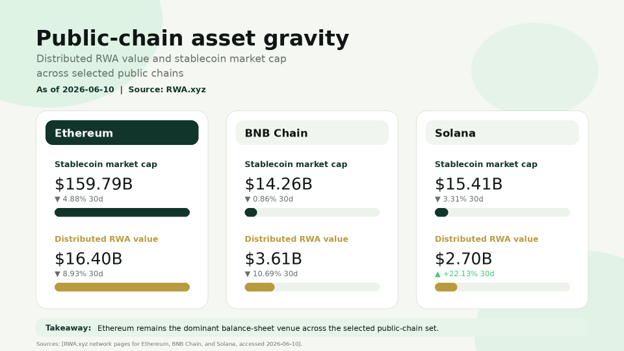
Ethereum already has the balance sheet of onchain finance. On RWA.xyz, Ethereum held about $16.40B of distributed real-world assets and about $159.79B of stablecoins as of June 10, 2026. BNB Chain was next at about $3.61B of distributed RWAs, and Solana sat at about $2.70B. Once real assets, stablecoins, and counterparties cluster in one place, the chain starts behaving like reference infrastructure.
Ethereum's roadmap now reads like financial infrastructure. In February, the Ethereum Foundation reorganized protocol work around Scale, Improve UX, and Harden the L1. That hardening track pulls in post-quantum readiness, trustless RPCs, censorship resistance work, and heavier testing as fork cadence picks up. Ethereum.org's roadmap also points to Glamsterdam in H1 2026 and Hegotá in H2 2026. For us, that matters because market-structure winners usually get chosen by trust, standards, and upgrade discipline before price catches up.
The path ahead is likely a hybrid one, and DTCC's tokenization stack already shows it. Its current networks are DTCC's AppChain, an Ethereum-compatible chain built on Hyperledger Besu, and Canton. DTCC says tokenized and traditional forms will share the same CUSIP and move across approved blockchain environments. Public and private systems will coexist, but the chains that matter most will be the ones other systems keep routing back toward.
Ethereum's advantage is not just that more assets sit there today. It is that the surrounding operating stack has already been built around it. Issuers want mature custody integrations, audited token standards, deep stablecoin liquidity, reliable oracle and data infrastructure, and a developer ecosystem that makes issuance, transfer, reporting, and servicing repeatable. That turns market share into operational leverage. Solana may keep winning speed-sensitive execution, and Canton may suit bilateral workflows where institutions want more privacy and control. But neither yet combines Ethereum's asset density, public-chain neutrality, and depth of institutional tooling. In our view, that is how default settlement layers emerge: not by winning every use case, but by becoming the place other use cases can route back to when they need liquidity, standards, and legitimacy.
Solana is the clearest public-chain counterweight because it wins on a different dimension. Its current upgrade slate focuses on faster confirmation, higher compute capacity, block revenue distribution, and validator economics. That should keep attracting builders and flow where execution speed and lower cost matter most. We still think Ethereum is doing the harder job, and the one that compounds more slowly but sticks longer: being the chain issuers, asset managers, and market infrastructure firms are willing to settle on when conditions get rough.
Canton has won attention because it fits today's comfort zone. The privacy model suits regulated workflows, and the network lets participants coordinate without putting every message in front of everyone else. Canton's own technical primer says participants can trust an existing synchronizer operator, form a consortium synchronizer, or use the Global Synchronizer run by supervalidators, with encrypted messages routed and ordered without exposing the underlying data. That may work inside a network of known institutions. We believe it is best understood as a bridge architecture. The trust surface is narrower, the information set is partial, and that is a harder foundation to underwrite for broad financial settlement.
In conclusion, we strongly believe that the surface area will be multi-chain. We still think Ethereum anchors the stack. It already has the asset gravity, its roadmap is built around staying credible as financial infrastructure, and even the more controlled environments keep routing back toward Ethereum compatibility, Ethereum standards, or both. That is why we believe Ethereum remains the default settlement layer.
--
DISCLAIMER: All views expressed are Hivemind’s own views. The information provided herein has been produced and issued by Hivemind Capital Partners UK LLP and/or Hivemind Capital Partners LLC (“Hivemind”) and is being provided for informational purposes only. This document is not to be distributed or reproduced in any way. This document does not constitute or contain an offer to purchase or sell securities. This document is confidential and intended for the person to whom this was delivered. If you have not received this document from Hivemind you are hereby notified that you have received it from a non-authorized source and you are prohibited from reading, using, retaining, disseminating or copying this material without the prior express written consent of Hivemind. Neither Hivemind nor any of its affiliates or representatives makes any representation or warranty, express or implied, as to the accuracy or completeness of the information contained herein or any other written or oral communication transmitted or made to the recipient. The information contained in this document is current as of the date indicated, and Hivemind undertakes no obligation to update, modify or amend this document or to otherwise notify a reader in the event that any matter stated herein changes or subsequently becomes inaccurate.This document has not been compiled, reviewed, or audited by an independent accountant. Past performance should not be construed as an indicator of future results, and there can be no assurance that historical trends will continue. This document does not include information regarding each investment or investment strategy pursued by the Funds. References to investments included herein should not be construed as a recommendation of any particular investment.Certain information contained herein may constitute “forward-looking statements,” which can be identified by the use of forward-looking terminology such as “may,” “will,” “should,” “expect,” “anticipate,” “project,” “estimate,” “intend,” “continue,” or “believe,” or the negatives thereof, other variations thereon or comparable terminology. All such forward-looking statements are solely statements of opinion, and there is no assurance that they will be predictive of actual events.